

Written by Junior Tadiffo, Open Mainframe Project Summer Mentorship 2026, mentee researcher, guided by mentor Bruno Azenha & Swathi Rao
About me and why this project
I am about to enter the final year of my Bachelor of Science in Computer Science at SUNY University at Buffalo. As an international student and technology ‘nerd’ from the earliest stages of my life, the choice was pretty easy.
In the first two years of my program, I built foundational skills that every computer scientist needs, including exploring different coding languages, algorithmic thinking, data structures and more. I made it a point of emphasis to explore different technologies and industries I am interested in during my junior and senior years of college. These include Sports analytics, Enterprise computing, Cloud, AI and ML in our society.
That rooted my interest in this project. As I grow in my tech journey, I find myself questioning the impact of technology on a more global scale and in geopolitics. This, together with my interest in enterprise computing, the mainframe, and the cloud, made this project an obvious choice for me. I get to research how governments approach the issues of digital sovereignty and resilience, the gaps in their actual strategies, and how the mainframe can help address them.
Importance the research question
Historically, sovereignty as a political concept refers to the power enjoyed by a governing body to rule over itself, free from any interference by outside sources or bodies. Digital sovereignty refers to the ability to regulate one’s digital future, encompassing infrastructure, software, standards, and data, as well as the regulations and jurisdictions that apply to them. Digital resilience, on the other hand, focuses on an organization’s ability to adapt, recover, and thrive in the face of digital disruption, utilizing the capabilities of digital technologies. Over the past decade and beyond, there has been a rise in concerns about digital sovereignty and resilience among major economies, most notably the EU, marked by the release of policies, acts, and initiatives such as Gaia-X.
Mainframe modernization efforts, coupled with the mainframe’s long-proven resilience, security, and availability, might have a significant role to play in filling the gaps in these areas. It emerges as a strong complement to the cloud, or as a viable replacement in some situations. This paper aims to evaluate the strengths and weaknesses of on-premise mainframe infrastructure compared to public cloud environments, specifically focusing on data residency, regulatory compliance such as DORA, and resilience models.
Progress done so far
Phase 1:
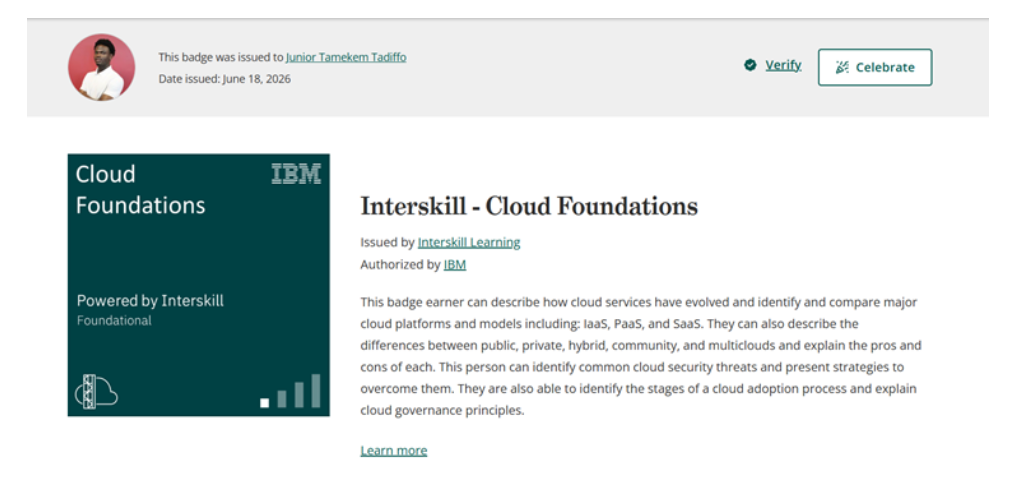
I deemed it important to brush up on my cloud computing knowledge before tackling this paper. To accomplish this, I took the “Cloud Foundations” course on Interskill.com. This course introduced the various components of cloud computing, along with its deployment models and service models. It also included a section on governance, which I believe is critical for this paper. Moreover, a number of real-world use cases were showcased, which helped me better visualize the current state of cloud adoption across different industries. Finally, the course went into technical detail on how the mainframe and z/OS Container Extensions (zCX) on z/OS can be used for cloud provisioning.
Phase 2:
In this phase, with the help of my mentors and a very insightful brain dump they provided to help me get started, I built a detailed table of topics and technologies I want to research. This helps guide my research and keeps me focused and on topic.
Phase 3:
I researched and read extensively about digital sovereignty and resilience, including data residency, infrastructure independence, pillars of resilience, regulations, and more. This gave me a clearer picture of the current state of these areas and the actual gaps that need to be filled.
Phase 4:
This is where I am right now. I have a shortlist of industry specialists I want to speak with. The next step is to contact them and propose interviews.
What’s Next
I still have a lot to cover. The next steps include:
- Interviewing experts to gather insights and sharper perspectives
- Tackling how the mainframe and mainframe vendors can address each of the identified gaps
- Building a visual and detailed comparison of the actual technologies involved, specifically the cloud and the mainframe, giving the reader a well-rounded view of the different options available to achieve digital sovereignty and resilience
- Finalizing the paper after review with my mentors, peers, and experts
I am forever grateful for this opportunity. Thank you to the Linux Foundation, the Open Mainframe Project, my mentors Swathi and Bruno, and everyone who is making this paper possible. I hope many people get to read this whitepaper and either learn a great deal or find a solid framework for making business decisions. See you all soon.
Stay tuned for more mentee blogs as our Summer Mentorship Program continues!
- Learn more about this year’s summer mentees and mentors
- Watch past mentee presentations on our Mentorship Playlist on YouTube
- Follow our blog for the latest updates from the program
- Connect with us on LinkedIn
- Sign up for our quarterly newsletter
