

Written by Ramana Sree K V, Open Mainframe Project Summer Mentorship 2026, mentee researcher, guided by mentor Misty Decker
First dispatch in a summer-long research project on where AI actually earns its place in mainframe modernization work.
In February 2026, IBM’s stock dropped sharply within days of a vendor announcement claiming that AI could dramatically accelerate COBOL modernization. By April, Gartner had published a report predicting that more than 70 percent of mainframe exit projects initiated in 2026 will fail to deliver their intended benefits, largely because organizations are overestimating what generative AI can actually do. Two narratives, months apart, pointing in opposite directions.
This is not a one-off disagreement. It is the shape of the entire conversation right now. One camp sees generative AI as the long-awaited breakthrough for an industry that has talked about modernization for three decades without much to show for it. Another camp sees a familiar pattern: a genuinely useful technology, misapplied to a problem it was never built to solve, dressed up by investor pressure and vendor marketing until the gap between promise and delivery becomes someone else’s very expensive lesson.
Both camps include serious people. Neither is short on evidence. So which one is right?
That is the wrong question to start with and getting to a better one is the point of this article, and of the research project it introduces.
I’m writing this as a mentee in the Open Mainframe Project’s Summer Mentorship 2026, at the start of a project built to sit inside that tension rather than resolve it prematurely. What follows is the case for why the question matters, and an invitation to the people best positioned to help answer it: the practitioners doing this work.
Why the Stakes Are Higher Than They Look
Mainframe modernization has always been hard. What makes this moment different is that three long-running pressures are converging at once.
The first is the workforce. The engineers who wrote and maintained decades of COBOL, PL/I, and Assembler are retiring faster than they’re being replaced, and much of what they know was never fully documented; it lived in their heads, encoded in edge cases and undocumented business rules baked into systems untouched for twenty or thirty years.
The second is the applications themselves. These are not peripheral systems. They run core banking, insurance claims, payroll, government benefits, airline reservations workloads where a subtle behavioral change during migration is not an inconvenience but an operational and financial risk. Gartner’s own analysis calls this the “too-big-to-fail” nature of mission-critical mainframe applications, and it’s precisely why migration decisions here carry more weight than most enterprise software choices.
The third is the AI moment itself. Generative AI has demonstrated real strength in reading and explaining code, arriving at the exact moment organizations were most anxious about losing the people who used to hold that knowledge. It’s a natural fit which is also why it’s easy to oversell.
Put those three pressures together and you get an environment primed for both breakthrough claims and expensive disappointment, sometimes from the same project.
There is also a cost dimension that doesn’t get enough attention in the public debate. Modernization and migration efforts at this scale are multi-year commitments, often running into eight or nine figures for large estates, competing for budget against every other transformation initiative on the roadmap. A project that quietly stalls two years in doesn’t just waste money it consumes the organization’s appetite for trying again, sometimes for a decade. That’s part of why the current moment matters: the decisions being made about AI’s role in modernization now will shape whether organizations attempt this work again soon, or shelve it indefinitely.
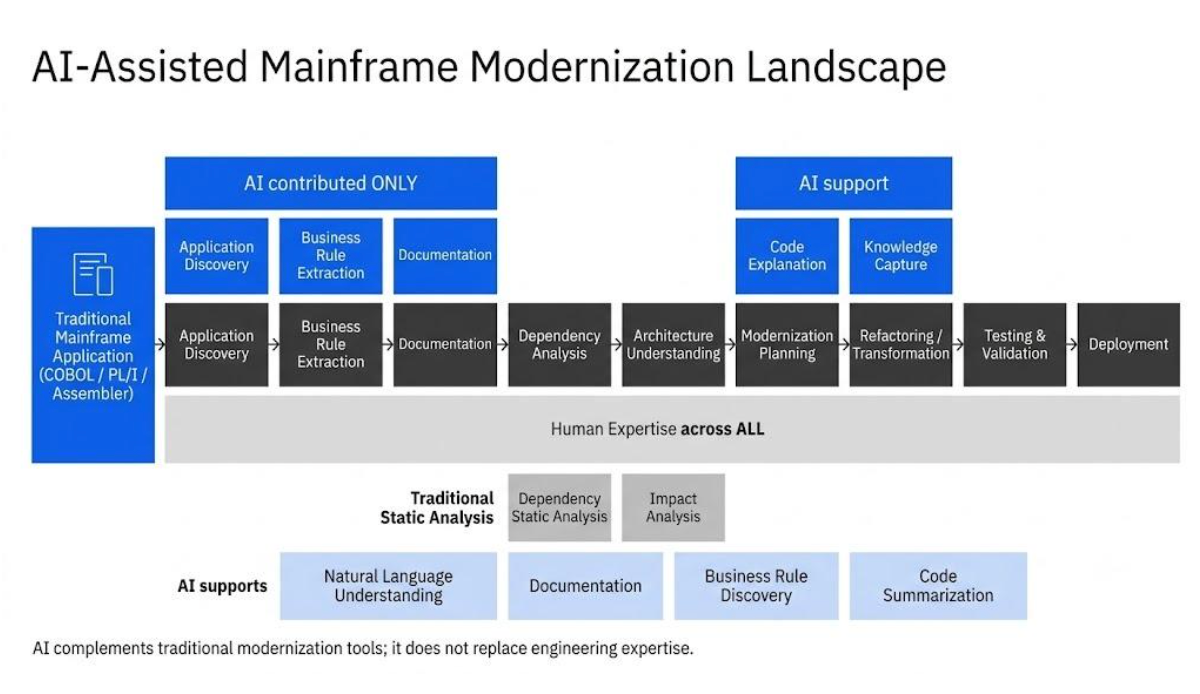
Fig 1: AI-Assisted Mainframe Modernization Landscape
Source: Created by Ramana Sree K V based on concepts discussed in Gartner research, IBM modernization guidance, and the Open Mainframe Project research framework.
Two Views, Both Grounded in Real Evidence
The optimistic view is not hype for its own sake. IBM’s watsonx Code Assistant for Z, which IBM has profiled in production use at organizations such as a national social-insurance agency, is built around exploring, documenting, and explaining existing COBOL applications before any transformation begins. It prioritizes discovery and understanding first, with refactoring and code conversion coming later. That sequencing is itself a data point: IBM structures its own tool’s lifecycle around the same distinction the skeptics draw. Rocket Software’s public commentary on the topic adds an unusually candid signal from a vendor with every incentive to oversell: it has cautioned that an AI-assisted COBOL-to-Java rewrite can produce code that is functionally identical but no more valuable on its own, and has focused more of its own recent AI investment on operational diagnostics than on wholesale code conversion. Set beside each other, these efforts point to the same place independent of any single company’s marketing: AI tools are increasingly effective at parsing legacy codebases, surfacing embedded business rules that were never written down elsewhere, generating documentation for systems that had none, and helping teams understand what a program actually does before anyone decides what to do about it. For organizations facing a knowledge gap left by retiring staff, that alone has real value.
The skeptical view is equally grounded. Gartner’s recent research draws a sharp line between what generative AI is good at today code understanding, discovery, documentation, and increasingly some operational tasks and what it still struggles with: automated conversion of legacy code into new languages or platforms, and preserving the exact business semantics decades of production use have quietly depended on. Their conclusion isn’t that AI has no place in modernization, but that many exit projects conflate “AI can explain this code” with “AI can safely migrate this code” and that gap, unexamined, is where projects fail.
Neither position is settled fact, and neither should be treated as the final word here. Vendors with a stake in AI-driven migration have their own data; enterprises running successful AI-assisted pilots have their own results; practitioners who have watched exit projects stall have war stories that don’t always match the analyst reports. Gartner itself draws a distinction that often gets flattened elsewhere: between modernizing an application in place and executing a full platform exit. Their research suggests AI currently offers more defensible value in the former than the latter a nuance a simple “AI works” or “AI doesn’t work” framing erases entirely.
Our research will treat the Gartner report the way it treats every other input: as one well-evidenced perspective worth testing against practitioner experience, not a conclusion to validate or overturn. The evidence right now is real, mixed, and still being written.
That’s precisely why this project leans on interviews rather than another comparison of press releases and analyst decks. The people who can actually settle what “defensible value” looks like are the ones who made the migrate-or-modernize call themselves, under real budget and risk constraints and those conversations are already getting underway.
About This Research
This project runs through the Open Mainframe Project’s Summer Mentorship 2026, a Linux Foundation program pairing mentees with practitioners across the open source and enterprise computing community. My project, guided by mentor Misty Decker, is titled “Role of AI in Mainframe Application Modernization.”
The mentorship model matters as much as the topic. This isn’t an opinion piece from a desk it’s a research process that gathers direct practitioner perspective, tests it against available evidence, and publishes findings the wider Open Mainframe Project and Linux Foundation community can use. The resulting white paper is meant to read like a field report, not a position paper grounded in what practitioners are seeing, not in what any analyst, vendor, or mentee predicted going in.
The methodology combines three threads: a structured review of existing literature and analyst research, used to sharpen the questions rather than settle them early; direct interviews with practitioners who have run modernization or exit projects and evaluated AI tooling against production systems; and a close look at cost-benefit and technical-limitation evidence, rather than relying on vendor claims alone.
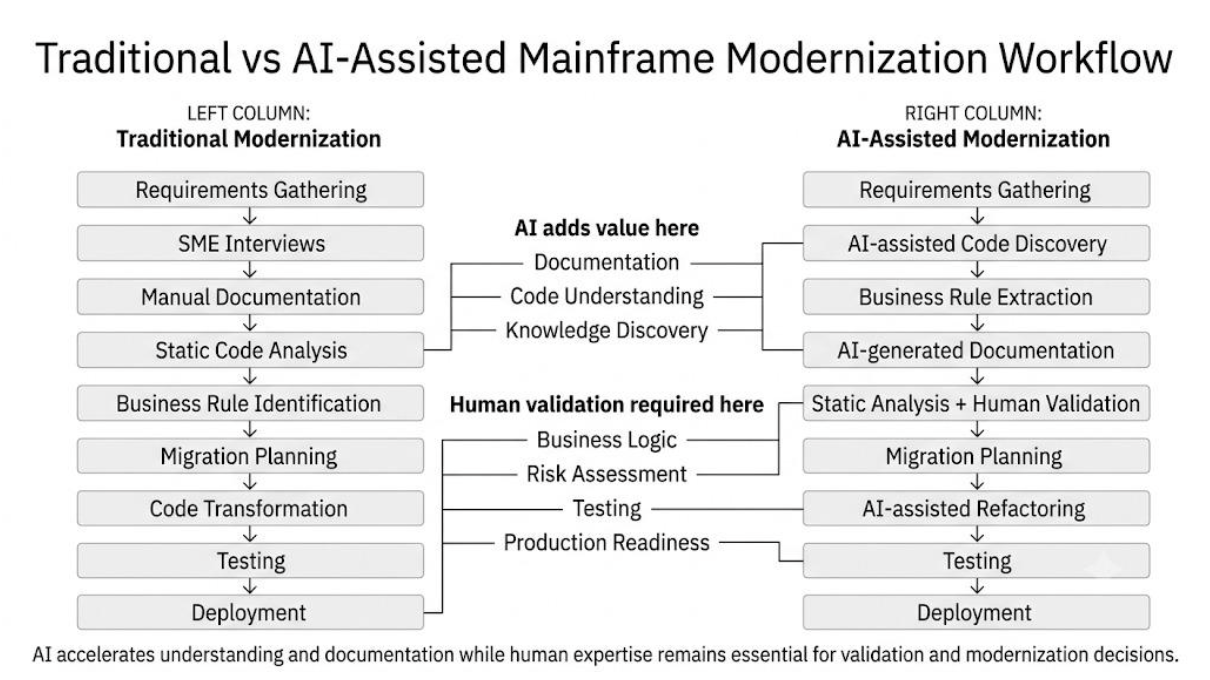
Fig 2: Traditional vs AI-Assisted Mainframe Modernization Workflow
Source: Created by Ramana Sree K V for this research article, illustrating a conceptual comparison between traditional and AI-assisted modernization workflows.
What Comes Next
Over the coming weeks, this research moves from framing the problem to gathering evidence. Interviews are already being scheduled, and future updates to this project will carry direct practitioner quotes, real modernization experiences, business rule extraction examples, and lessons learned alongside the analysis below. That work includes:
- Structured interviews with modernization architects, consultants, and technical leaders
- A closer look at AI-assisted business rule extraction, since it sits at the center of both the optimistic and skeptical cases
- A parallel look at where traditional, non-AI modernization approaches still outperform newer tooling
- Cost-benefit analysis grounded in real project data rather than vendor projections
- A clear-eyed account of the technical limitations that don’t surface until a project is well underway
- Direct practitioner perspectives including views that disagree with each other, and with the analyst community
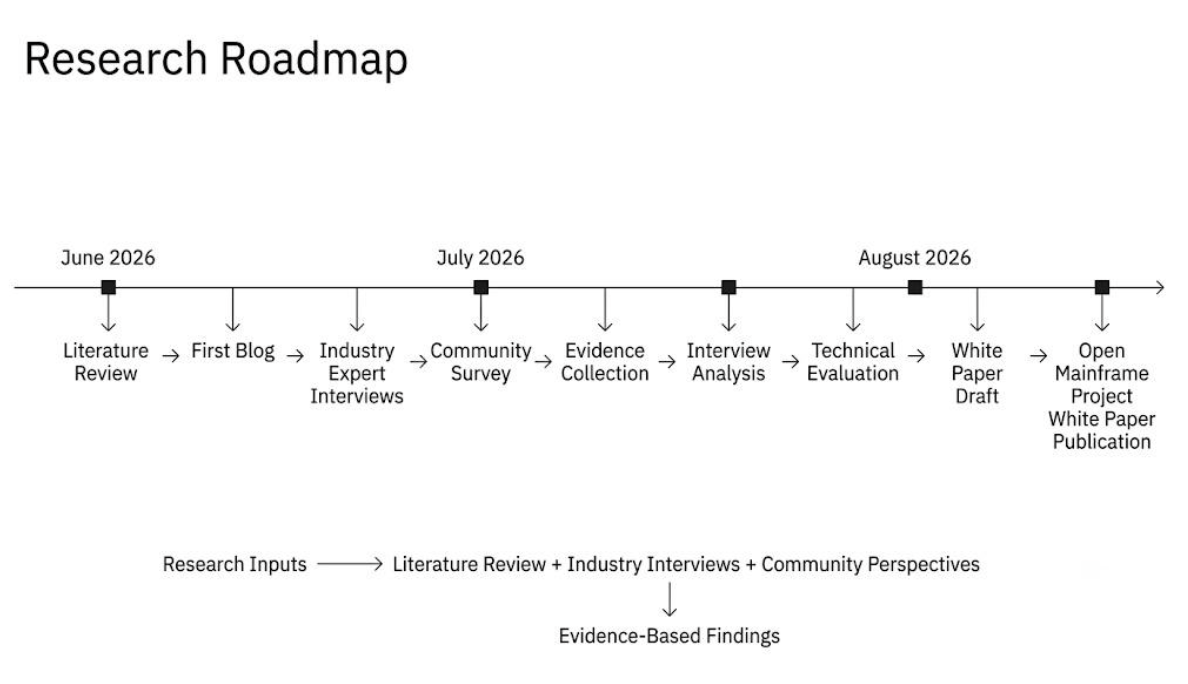
Fig 3: Research Roadmap
Source: Created by the author to illustrate the planned research methodology for the Open Mainframe Project Summer Mentorship 2026.
None of this is designed to arrive at a predetermined answer. It’s designed to produce evidence and that evidence needs to come from people who have actually done the work, not from a single analyst report or a single mentee’s hypothesis walking in the door.
This is where the Open Mainframe Project’s model works best: practitioners comparing notes in the open, rather than one report or vendor getting the final word. If you’ve run a mainframe modernization or exit project successful, failed, or in between or evaluated AI tooling against production COBOL, PL/I, or Assembler systems, your experience is exactly the input this research needs. That invitation goes specifically to architects, modernization leads, and technical decision-makers across IBM, Rocket Software, Kyndryl, Broadcom, BMC, AWS, Google Cloud, DXC, Ensono, and the wider mainframe ISV and managed-services community as well as enterprise customers and independent consultants who’ve made these calls under real budget and risk constraints. If that’s you, let’s build this together: reach out on LinkedIn, by email at Gmail, or through the Open Mainframe Project’s Modernization Working Group. Fifteen minutes is enough to start a conversation that could shape the white paper.
Students, researchers, and AI engineers are welcome in this conversation too. The research will be stronger from an outside perspective. Comment, share it with someone who has a strong opinion on this topic, or reach out directly if you’d rather contribute privately. Later updates to this project will carry these voices directly, in their own words.
The Question Worth Asking
The industry keeps asking, in one form or another, “will AI replace COBOL?” It’s an understandable question, and also the wrong one. It assumes a single, binary outcome for a technology that is clearly strong in some parts of the modernization pipeline and clearly weak in others and it invites a yes-or-no answer to a problem that has never been that simple.
The more useful question is narrower and harder: where, specifically, in the long chain from legacy code to modernized system, does AI create value that survives contact with production?
I don’t have that answer yet. Nobody credibly does, today in July 2026 which is why this research exists. The conversation begins today. The evidence comes next. The white paper, targeted for this August, won’t tell you whether AI will save the mainframe or oversell itself trying. It will tell you, as precisely as the evidence allows, where the value actually is.
Follow along. Better yet, help build it.
Stay tuned for more mentee blogs as our Summer Mentorship Program continues!
- Learn more about this year’s summer mentees and mentors
- Watch past mentee presentations on our Mentorship Playlist on YouTube
- Follow our blog for the latest updates from the program
- Connect with us on LinkedIn
- Sign up for our quarterly newsletter
