

The GS UK Virtual Conference, which happened on April 21-23, brought together voices from across the open source and mainframe ecosystem for a day of insight, collaboration and forward-looking discussion. For the third year in a row, Open Mainframe Project had a stream at the event. Sessions highlighted how organizations are modernizing critical infrastructure, advancing open source innovation on the mainframe and building stronger technical communities through shared expertise and real-world experience.
Mainframe operations have long relied on institutional knowledge passed down through careful instruction and meticulous notes. At this year’s GSUK Virtual Conference, Joshua Powell and Miroslav Strnad from Broadcom’s Mainframe Software division made the case that those same operations can be scripted, automated, and integrated with modern tooling: without abandoning what already works. Watch the full video here.
The scenario
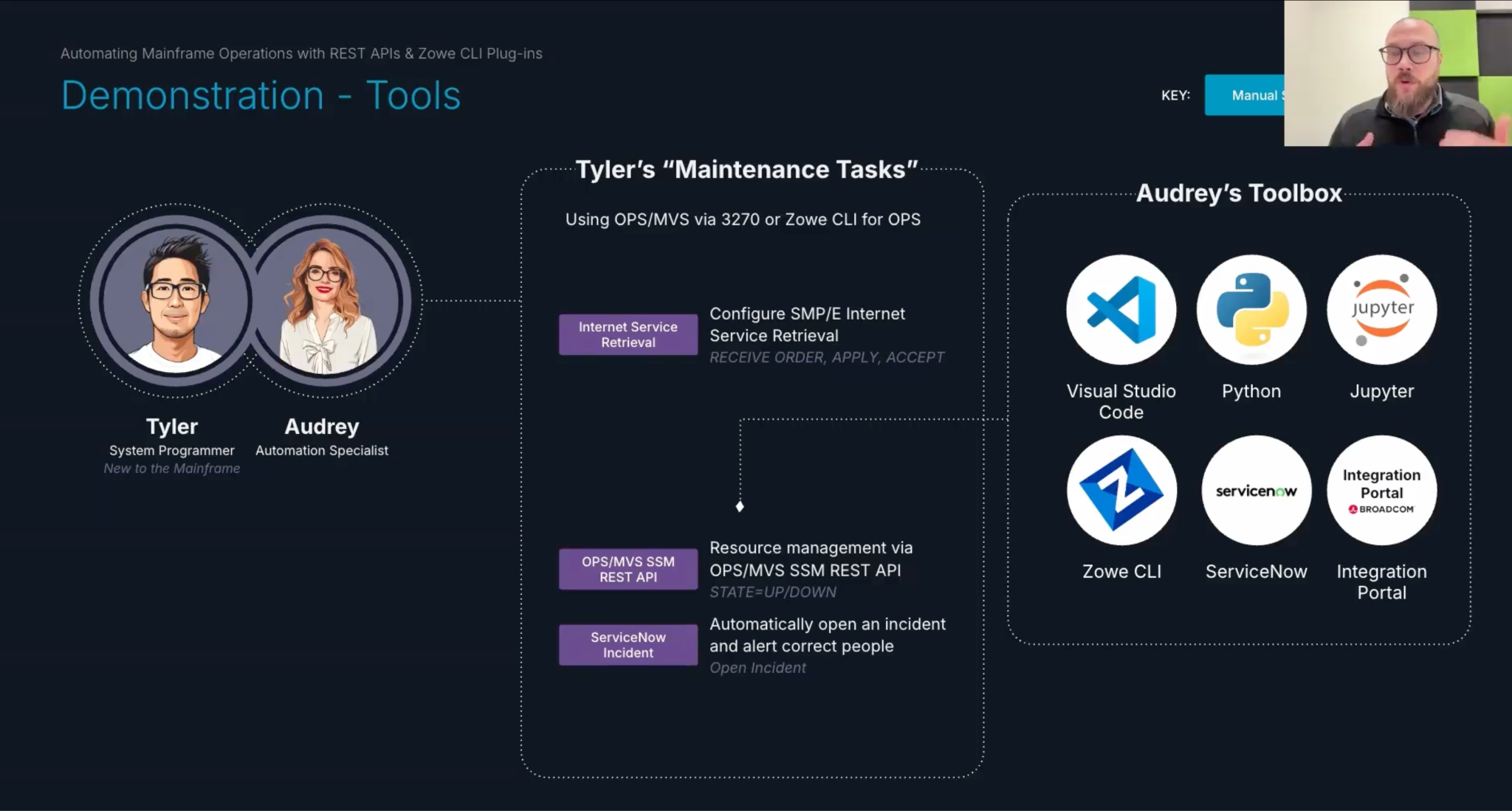
Joshua opened with a story that will feel familiar to many teams. Tyler is a newer system programmer who has been trained by Sherman, a long-tenured colleague preparing to hand off responsibilities quickly. Tyler manages a mainframe application made up of three separate resources running across sandbox, QA, and production environments.
His current workflow is manual by design. He takes a resource down, applies a PTF, verifies the maintenance, and restarts. Then repeats the same steps for each prerequisite resource. The process works. It just takes time, and any deviation requires careful troubleshooting.
Enter Audrey, an automation specialist brought in to help Tyler do the same work with scripts instead of manual steps.
The toolchain
The demo ran entirely in Visual Studio Code using Jupyter Notebooks, which let Joshua walk through Python code block by block rather than firing off a full script all at once. The notebook format also doubles as documentation, inline markdown cells explain each step for anyone who picks up the notebook later.
The dependency list was intentionally short. The main addition was the requests library, which handles the REST API layer. Everything else (getpass for credential input, json for encoding and decoding responses) comes with Python’s standard library.
For authentication, Joshua used getpass to collect credentials interactively without hardcoding them into the notebook. He also flagged a cleaner option for real environments: using Zowe CLI’s authentication so the notebook pulls credentials from a profile rather than prompting at runtime.
What the API actually does
The automation target was OPS/MVS, Broadcom’s operations automation product. Using the Broadcom Mainframe Integration Portal (integration.mainframe.broadcom.com) as a reference for Swagger documentation, Joshua walked through a progression of requests:
- A GET request to check the status of the OpsMVS API
- A GET request to look up a specific resource by name and inspect its current state and prerequisites
- A PUT request to change the resource state from up to down, with the API handling prereq awareness automatically, bringing dependencies down in the right order
- A second PUT request attempting to bring the resource back up
That last step included a deliberate error. When the resource failed to come up, Joshua showed how the same request pattern (URL, authentication, payload) translates directly to a ServiceNow API call. A POST request to ServiceNow’s incident endpoint created a ticket automatically, no UI required. A 201 response confirmed the ticket was created.
After simulating the fix, the final PUT brought the resource back to its original state, confirmed both through the API response and a live 3270 terminal view.
The bigger picture
Mirek walked through the Mainframe Integration Portal, which Broadcom built in direct response to customer requests for a single public place to find REST API documentation across all products. No login, no firewall restrictions for public internet users. The portal includes Swagger docs, use case examples, getting-started guides, and links to community spaces where engineers and customers discuss integration approaches.
He also highlighted that while REST APIs are a strong starting point for automation, Open Mainframe Project’s Zowe CLI plugins offer another layer of abstraction, and Broadcom’s Ansible collection covers broader orchestration needs for teams ready to scale beyond individual scripts.
Why it matters
The core takeaway from Joshua and Mirek’s session was structural. GET, PUT, and POST requests using URLs, authentication, and payloads are not mainframe-specific patterns, they are standard HTTP. Once Tyler writes the code to bring a resource down and verify its state, he has most of what he needs to bring it back up, check prerequisites, and file an incident. The same small code block, slightly adjusted, does all of it.
That reusability is the point. Manual steps that once required switching between a 3270 terminal and multiple tools can be scripted, sequenced, and handed off,with the notebook itself serving as the documentation for whoever comes next.
Resources from the session
The GitHub quick-starts linked in the presentation cover: setting up an API playground in VS Code, running the full notebook from the demo, and connecting securely to a mainframe using Zowe authentication.
- Broadcom Mainframe Integration Portal — integration.mainframe.broadcom.com
- Zowe documentation — zowe.org
- Broadcom Ansible Collection — available through the integration portal
Keep up to date with Open Mainframe Project:
- Connect with our LinkedIn page
- Sign up to get our quarterly newsletter
- Subscribe to our Youtube Channel
- Bookmark our Flickr channel
- Follow us on X at @Openmfproject
